


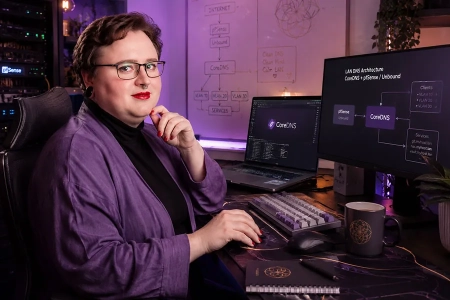
 CoreDNS at Home: Reclaiming Local DNS from pfSense
Local DNS starts out harmless: a few host overrides here, one internal service there. But once VLANs, multiple interfaces, and a growing homelab enter the picture, those convenient little firewall UI entries turn into hidden infrastructure state. In this post, I walk through how I moved my LAN DNS from pfSense host overrides to a clean CoreDNS-based control plane — fast, deterministic, reproducible, and finally aligned with how the network actually works.
Read
CoreDNS at Home: Reclaiming Local DNS from pfSense
Local DNS starts out harmless: a few host overrides here, one internal service there. But once VLANs, multiple interfaces, and a growing homelab enter the picture, those convenient little firewall UI entries turn into hidden infrastructure state. In this post, I walk through how I moved my LAN DNS from pfSense host overrides to a clean CoreDNS-based control plane — fast, deterministic, reproducible, and finally aligned with how the network actually works.
Read
A new generation of insurance companies is trying to rebuild commercial insurance around software, better data and a customer experience designed for founders rather than insurance departments.
One particularly interesting example is Corgi, a fast-growing American full-stack insurer built around startups and technology companies. Unlike a digital broker that places policies with established carriers, Corgi underwrites and issues insurance itself. It combines conventional commercial coverage with modern distribution, startup-oriented packaging and products for emerging risks such as artificial intelligence.
The company is already expanding into the United Kingdom. That raises a different question:
What happens after the comparatively familiar bridge into London – when this model encounters the European Union?
To explore this, let us create a fictional company.
Meet Dachshund, an AI-native commercial insurer for European technology companies. It offers cyber insurance, professional liability, D&O and dedicated protection for companies building or deploying AI. Applications take minutes. Coverage is modular. Technical controls influence underwriting. Policy documents are written for operators rather than insurance specialists.
Dachshund has the interface of a software company, the ambitions of a venture-backed startup and the balance-sheet responsibilities of an insurer.
Now it wants to expand across the EU.
What could possibly go wrong?
The opportunity is real
European companies do not enjoy confusing insurance applications, fragmented policies or weeks of uncertainty any more than American founders do.
A SaaS company may need some combination of professional liability, cyber insurance, D&O, legal protection and business-interruption coverage. Yet the risks it actually worries about are expressed rather differently:
- What happens if our platform goes down?
- What if an automated decision causes a customer loss?
- What if an employee exposes confidential data?
- What if a model produces legally problematic content?
- What if an AI agent performs an action nobody explicitly approved?
- What if a regulator investigates our use of customer data?
Traditional insurance categories do not always map intuitively onto these questions. A company can own several policies and still be uncertain which one would respond – or where one insurer's responsibility ends and another begins.
That is Dachshund's first opportunity: not merely selling insurance online, but translating modern operational risks into understandable coverage.
The second opportunity is underinsurance.
Cyber risk is now inherent to almost every business, yet many smaller companies remain uninsured or inadequately protected. Munich Re describes a substantial cyber-protection gap, particularly among SMEs, and identifies complexity as one obstacle to wider adoption.
Artificial intelligence adds another layer. The companies deploying it are creating new dependencies, decision pathways and liability questions faster than conventional product cycles can comfortably absorb them.
Europe therefore has no shortage of potential demand. The harder question is whether a new insurer can reach that demand economically – and assume the resulting risk responsibly.
One interface, many markets
The United States is hardly a simple insurance market. State regulation, licensing and policy requirements create significant complexity.
The EU, however, presents a different type of fragmentation.
Dachshund can build one technical platform, one brand and one broad risk philosophy. It cannot assume that one product, one distribution model or one message will work equally well across Germany, France, the Netherlands, Ireland, Austria and the Nordics.
Commercial expectations differ. Legal systems differ. Policy language differs. Broker relationships differ. Company structures differ. Even the meaning of a reassuring insurance brand differs.
A founder in Amsterdam may be comfortable completing an entirely digital application in English. A medium-sized German company may expect a named specialist, extensive documentation and evidence that claims will be handled locally. A French customer may require another product and distribution architecture again.
Switzerland and Norway may be attractive adjacent markets, but they introduce their own frameworks rather than simply extending an EU rollout.
This does not make pan-European expansion impossible. It changes its architecture.
Dachshund would not really be launching into "Europe". It would be building a shared European operating system with market-specific insurance products layered on top.
That distinction is expensive.
It means localization is not a translation task completed shortly before launch. It affects underwriting, contracts, claims, support, partnerships, compliance and go-to-market strategy from the beginning.
Europe is not waiting for digitalization
It would be easy – but wrong – to portray this as a battle between an innovative American model and an analog European insurance industry.
European insurers are already adopting AI and digital processes. EIOPA reported that roughly half of surveyed non-life insurers were using AI across parts of their value chain by 2024, with further adoption in progress. Automated tools are already influencing pricing, fraud detection, customer service and claims processing.
Incumbents also possess assets Dachshund cannot manufacture through a clever interface:
- established claims operations
- actuarial experience
- regulatory relationships
- specialist underwriting knowledge
- trusted distribution networks
- large pools of historical data
- substantial capital and reinsurance access
A new entrant does not win because established insurers have never heard of machine learning.
It wins where legacy assumptions still shape the product.
Existing insurance is often organized around internal categories, historical lines of business and established distribution structures. Dachshund can begin with the customer's actual operating system: its software stack, dependencies, business model, technical controls, contractual exposure and use of AI.
The question is therefore not whether European insurance becomes digital. It already is.
The more interesting question is:
What can a company design differently when it does not begin with the organizational boundaries of a century-old insurer?
The interface can move fast. The risk cannot.
Dachshund's easiest advantage would be speed.
It could replace long questionnaires with adaptive applications, extract relevant information from existing documents and connect to selected technical systems. A SaaS company might provide evidence of its identity controls, backups, security policies, cloud architecture and incident-response procedures rather than repeatedly describing them in generic forms.
Companies with demonstrably strong controls could receive faster decisions or better conditions.
That creates a compelling loop:
Better controls produce better understood risks. Better understood risks enable more precise pricing. Better pricing gives companies an incentive to improve their controls.
But this is also where the attractive software story collides with insurance economics.
A fast application does not make an uncertain risk predictable.
AI related liability presents particularly difficult questions. There may be little historical claims data for a new category of autonomous system. Responsibility may be distributed across the model developer, infrastructure provider, application company, integrator and customer. One underlying provider or software dependency could affect hundreds of insured companies at once.
This is accumulation risk disguised as product innovation.
If Dachshund uses low prices to acquire every company that established insurers consider difficult, it may not be disrupting the market. It may simply be collecting adverse selection at venture speed.
The winning promise cannot be:
We insure unfamiliar risks more cheaply than everyone else.
It has to be:
We understand modern risks more precisely – and reward companies that help us verify them.
That is a more defensible proposition, although a less theatrical one.
Direct distribution meets institutional trust
A direct model appears attractive. Dachshund owns the customer relationship, gathers better data and avoids paying part of the premium to intermediaries.
In some European segments, that could work well. Technology founders already purchase important infrastructure online. They are accustomed to evaluating cloud providers, payment systems and legal tools without visiting a local office.
Insurance, however, is purchased today and tested under stress years later.
The quality of the buying interface matters. The perceived ability to resolve a serious claim matters more.
This is particularly visible in established markets such as Germany, where brokers, advisors and longstanding insurer relationships do not exist only because nobody has built a sufficiently elegant website. They also transfer trust, interpret complex products and provide a human escalation path.
Dachshund therefore faces a choice.
It can treat intermediaries as obsolete friction and attempt to replace them entirely. Or it can distinguish between friction that should disappear and expertise that customers still value.
The likely European model is hybrid:
- direct digital purchasing for straightforward risks
- specialists for complex or unusual cases
- selective broker and ecosystem partnerships
- automated evidence collection
- human accountability in underwriting and claims
- local support when a company faces a serious incident
In other words: software speed at the surface, institutional credibility underneath.
That may reduce the purity of the direct-to-customer model. It may also make the company substantially more viable.
Dachshund's decision map
Several strategies look attractive in isolation. Their trade-offs become clearer when placed next to each other.
| Strategic decision | Attractive because | Dangerous because |
|---|---|---|
| Launch across many EU markets | Creates scale and a large narrative quickly | Localization can overwhelm learning and operations |
| Compete aggressively on price | Accelerates customer acquisition | Attracts poorly understood and disproportionately risky customers |
| Lead with AI insurance | Creates differentiation and category ownership | Loss history is limited and exposures may be correlated |
| Sell entirely direct | Preserves margin and customer data | Ignores trust and advisory structures in some markets |
| Use brokers selectively | Adds credibility and qualified distribution | Reduces margin and weakens control over the relationship |
| Target all SMEs | Produces a vast theoretical market | Creates generic positioning and highly heterogeneous risks |
| Begin with technology companies | Aligns product, data and messaging | Limits initial volume and creates concentration |
| Automate underwriting heavily | Reduces cost and improves speed | Can create opacity, governance problems and false confidence |
The most plausible strategy is not the boldest individual option.
Dachshund would probably begin with a narrower group of SaaS, AI and digitally mature companies across a small number of compatible markets. It would combine direct distribution with carefully selected partners. AI-related coverage would be tied to observable governance and technical controls rather than broad, poorly bounded promises.
Its shared platform could scale across the EU. Its market entry would remain deliberately uneven.
The Netherlands, Ireland and selected Nordic ecosystems may offer digitally receptive entry points. Germany and France provide greater depth but demand stronger localization, distribution and trust infrastructure. Switzerland and Norway may become attractive adjacent opportunities once the core model is proven.
The sequence matters because insurance punishes premature scale differently from ordinary software.
A SaaS company expanding too quickly may create support problems. An insurer expanding too quickly may discover years later that it misunderstood the risks it accumulated.
What established insurers could learn from Dachshund
Dachshund is not automatically superior to the incumbents it challenges.
Its fictional value lies in exposing which insurance conventions are necessary – and which merely persist because the system was built around them.
An established European insurer could examine the same simulation from the opposite direction:
- Could products be organized around a company's stage and operating model rather than insurance terminology?
- Could technical controls influence underwriting more directly?
- Could customers understand their relevant exclusions before a claim?
- Could cyber prevention, incident response and coverage become one integrated service?
- Could a quote take minutes without making the underlying risk assessment superficial?
- Could AI companies receive coverage reflecting their actual role as model provider, integrator or deployer?
- Could brokers spend less time moving information and more time interpreting consequential risk?
Incumbents do not need to imitate the culture, branding or growth model of a Silicon Valley startup to learn from its architecture.
Likewise, Dachshund would eventually need to learn why conservative insurance practices exist. Capital discipline, careful wording, reinsurance, claims expertise and regulatory oversight are not legacy defects. They are parts of the machinery that prevent attractive promises from becoming unfunded ones.
The strongest European insurer may therefore be neither a traditional carrier with a modern portal nor a software company that happens to issue policies.
It may be a company capable of combining the best instincts of both.
The verdict
Dachshund could work.
The demand exists. Commercial insurance remains difficult to understand. Many smaller businesses remain inadequately protected against digital risk. AI creates new exposures that do not always fit comfortably into existing products. Modern underwriting can use richer operational evidence than a static annual questionnaire.
But the European version would not be a translated American insurer.
It would be a hybrid institution: technologically centralized but locally credible; direct where simplicity is valuable and assisted where judgment matters; ambitious in distribution but conservative in risk; willing to design new products without pretending that unfamiliar liabilities are easy to price.
The same forces that make Europe difficult may eventually become its moat. A company that succeeds in earning regulatory legitimacy, modeling emerging risks and winning trust across several markets will have built something much harder to reproduce than an elegant quoting flow.
The broader lesson extends beyond insurance:
Business models cross borders more easily than the systems beneath them.
Corgi provided the spark for this thought experiment. Dachshund reveals the larger strategic problem.
When a successful model enters a different market, the central question is not whether it can be copied. It is which assumptions survive, which ones break – and what stronger system might be built from the collision.
Dachshund is a fictional company used to explore the strategic translation of an AI-native insurance model into the EU. This is not a market-entry proposal for any particular insurer, nor a substitute for jurisdiction-specific regulatory, actuarial or legal analysis.
This simulation follows the same method I use for Overnight Founder Clarity: taking an ambiguous strategic question, mapping the systems around it, identifying consequential decisions and risks, and turning the resulting complexity into a clearer operating landscape.
This simulation follows the same method I use for Overnight Founder Clarity: taking an ambiguous strategic question, mapping the systems around it, identifying consequential decisions and risks, and turning the resulting complexity into a clearer operating landscape.


No Comments Yet
Add a comment